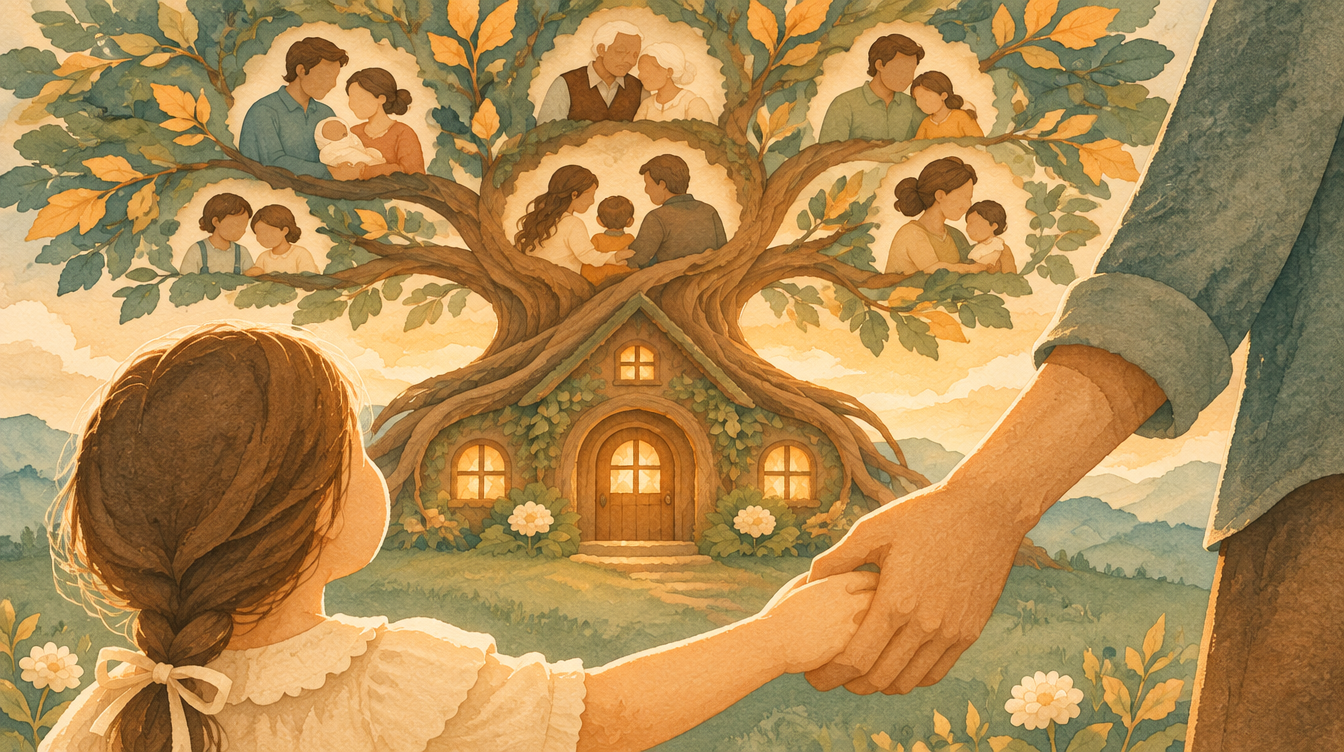
Chapter 3 begins: “In this chapter I invite you to draw back the veil and discover what lies behind Ian and Cary’s story. Often you cannot know the present without first understanding the past.”
A map of three generations
To study the couple’s past, the chapter uses the genogram, a tool that “looks at the influence of the last three generations on the couple’s present and analyzes the emotional dynamics, maladaptive behaviors, and tendencies that shaped the couple’s reality.”
The book applies it to Ian’s and Cary’s family histories. It says the emotional dynamics people live in their families are carried into their relationships.
“You can’t heal from what you don’t know”
“Your family teaches you how to relate to other people in life,” the chapter says, and “The emotional dynamics we experience in our families are the same emotional dynamics we bring to our marriages.” The chapter’s line: “You can’t heal from what you don’t know.”
Attachment theory in plain words
The chapter presents attachment as part of human life “from cradle to grave,” and credits John Bowlby and Mary Ainsworth. Secure attachment, it says, “depends on two factors: (1) the ability to predict that parents will respond to their needs and (2) their ability to trust that their parents will consistently respond to their needs.” Children with secure attachment use their parents as a “safe base” for exploring and as a “safe haven” in times of stress or danger.
The chapter lists five conditions for a child to develop secure attachment. The child feels safe. The child feels recognized. The child feels comfort, calm and tranquility. The child feels valued. The child feels supported to explore.
Three insecure styles, and one pairing
When parents are not present in a child’s life, the chapter says, the child develops an insecure style: anxious-preoccupied, anxious-avoidant, or disorganized or fearful. The book describes Cary’s as anxious-preoccupied, where a child “is unable to cope with the caregiver’s absences and as a result, constantly seeks reassurance.” It describes Ian’s as anxious-avoidant: “For years, his strategy was to avoid any emotional connection to avoid being hurt.”
In the disorganized style, “the child is in a paradox without a solution: the child can neither approach, nor avoid or escape from the attachment figure that hurts him or her.”
Of the pairing Ian and Cary formed, the book says: “the anxious partner feels abandoned while the avoidant partner shows rejection of his or her partner’s dependency needs.”
Two questions, and a timeline
Safety first. If you are hurt, threatened, controlled or afraid of your partner, skip the shared exercises. National Domestic Violence Hotline: 800-799-7233, or text START to 88788 (24/7, free, confidential). Use a safe device, one your partner cannot see or check. In danger, call 911.
The chapter asks: “Do you know your attachment style? Do you understand why you relate the way you do to your partner?” It then offers a 12-statement attachment test, with the reminder: “There are no right or wrong answers. Please answer honestly.” A second exercise asks you to mark, on a timeline from birth to your twenties, when you first felt a difficult feeling, and then to “Put aside your pen or pencil and take a deep breath.”
The attachment test is informal. It is a way to start thinking, not a diagnosis, and attachment can change over time.
If looking back stirs up painful memories, or if your childhood included abuse or neglect, you do not have to go through them alone. A licensed therapist can help. Skip any exercise that feels like too much.
Keep reading
Chapter 4 turns to what comes before the family: why people were made for connection in the first place. In HEAL. LOVE. CONNECT. each chapter gives a description of a problem, some key concepts to understand it, and practical solutions.
Dr. Efrain Duany is a Licensed Marriage and Family Therapist (LMFT-S) and the author of HEAL. LOVE. CONNECT. (Amor Seguro).
This article is education, not therapy, and results vary. If you feel your relationship needs support, seek out a licensed therapist.
Keep reading
 Family
The influence of a mother in today’s world
When Kevin Durant accepted the NBA's Most Valuable Player award in 2014, he used his speech to honor his mother. He…
 Family
Who is educating your child?
How important is the influence parents have on raising their children? Have we asked ourselves that question? The…
 Addiction
How do emotional traumas develop in families?
Families are living on a battlefield. The situations in our society have made it this way. How do emotional traumas…